
Author: Site Editor Publish Time: 2026-01-30 Origin: Site


In modern manufacturing, injection molds are widely used in industries such as automotive, electronics, medical, and consumer goods, and are core process equipment for achieving high-efficiency, large-volume, and stable molding. However, many buyers or engineers often mistakenly understand injection molds as a single "mold block."
From an engineering perspective, an injection mold is a highly integrated system composed of numerous mold components and mold tooling parts. Each component performs a clear and irreplaceable function. From the transportation, molding, and cooling of molten material to the final demolding, all steps depend on the coordinated work of these precision parts.
This modular and systematic mold structure concept also applies to die casting molds. Although injection molding and die casting differ in materials and processes, they share a high degree of commonality in mold structure design, core component division, and precision machining requirements.
Based on product structure complexity, production volume requirements, and production cycle, various types of injection molds have been developed. The differences between these types essentially lie in the combination and functional configuration of mold tooling parts.
Family Molds
Family molds achieve simultaneous molding of multiple parts by setting multiple cavities with different structures in the same mold. This type of mold requires extremely high balance in mold components; otherwise, problems such as uneven cooling and dimensional deviations may occur.
Two-Plate & Three-Plate Molds
Two-plate molds have a simple structure and low cost, suitable for parts with simple structures; three-plate molds, by adding a runner plate, allow for more flexible gate positions, suitable for complex products. These types of molds require higher precision in the machining of mold tooling parts such as the runner system and guiding system.
Stack Molds & Multi-Shot Molds
Stack molds significantly increase production capacity through spatial stacking, while multi-color and multi-material molds rely on rotating or sliding structures to complete multiple injections. These advanced mold designs demand extremely high precision in the assembly of mold components, precise synchronous control capabilities, and meticulous material matching. Similar logic applies to high-end applications of die casting molds.
Regardless of the mold type, its core structure revolves around several fundamental systems, which together form the "skeleton" of the injection mold.
Cavity & Core System
The cavity and core determine the external shape and internal structure of the product, making them the most critical parts among all mold components. They need to withstand high-pressure injection forces and maintain dimensional stability through repeated cycles, which is especially important in high-load die casting molds.
Runner & Gate System
The runner system is responsible for stably transporting the molten material from the injection unit to the cavity. The choice between cold and hot runners directly affects material utilization, molding quality, and production costs.
Cooling System
The cooling system often accounts for more than 50% of the injection molding cycle time. Efficient cooling design not only improves production efficiency but also reduces defects such as deformation and internal stress. In both injection molds and die casting molds, cooling and temperature control remain one of the core issues in mold design.
Ejection & Guiding System
The ejection system ensures the smooth demolding of the molded part, while the guiding system ensures precise alignment of the mold during each opening and closing cycle. The stability of these mold tooling parts directly affects mold life and product consistency.
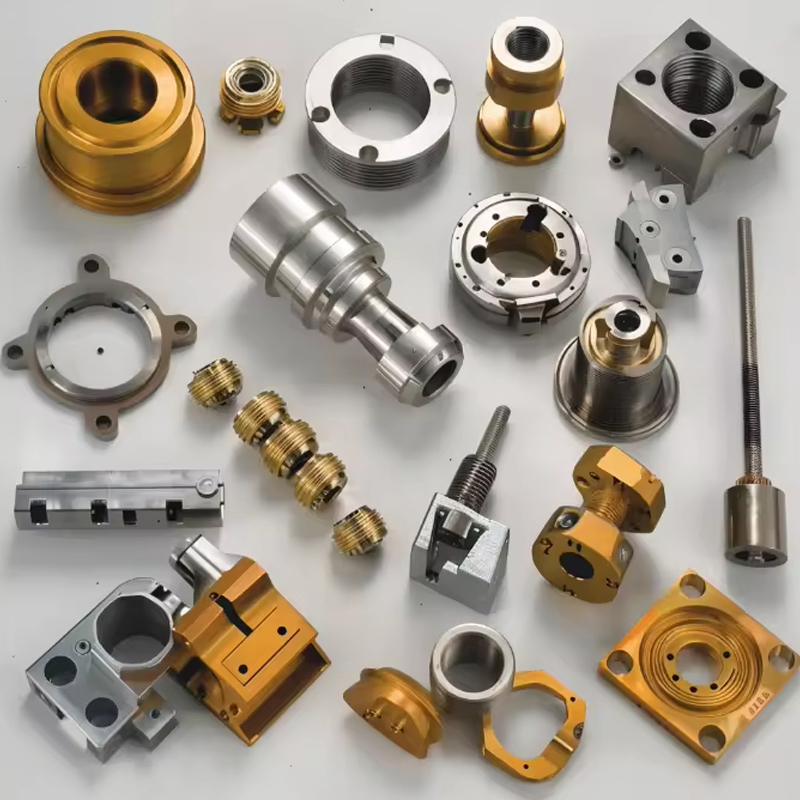
Although injection molds are primarily used for thermoplastic materials, and die casting molds are for molten metals, the two share a high degree of similarity in structural design concepts. Mold bases, cores, cavities, cooling channels, guiding and ejection systems are all common mold components in both types of molds. The only difference is:
Die casting molds require higher heat resistance and wear resistance.
Mold components typically need to withstand higher temperatures and impact loads.
Therefore, suppliers with high-precision CNC machining capabilities and extensive experience in manufacturing mold tooling parts can often serve both injection molding and die casting mold industries, providing customers with more flexible manufacturing solutions.
An injection mold is essentially a precision engineering structure composed of multiple highly coordinated systems and components. The rationality of the design, machining accuracy, and assembly quality of the mold components determine the molding capability, stability, and service life of the mold. This principle also applies to high-end molding dies such as die casting molds.
For procurement teams and engineering teams, a deep understanding of the structural logic and functional division of mold tooling parts helps in making more informed decisions during mold selection, manufacturing, and maintenance, and makes it easier to identify precision manufacturing partners with true long-term value.


